How Resorts Can Reduce Water Consumption Through Varuna Bio Pure Decentralized Treatment Systems
Discover how Varuna Bio Pure decentralized wastewater treatment systems help resorts reduce water consumption, enable water reuse, and support sustainable hospitality operations.
Not long ago, a resort consultant shared something interesting during a discussion about sustainability.
He wasn't talking about solar panels.
He wasn't talking about plastic waste.
He wasn't even talking about energy efficiency.
He was talking about water.
More specifically, he was talking about how little attention water receives until it becomes a problem.
That observation stuck with me.
Think about it for a moment.
Guests rarely think about water when they check into a resort. They notice the ocean view, the swimming pool, the landscaping, and the quality of the room.
What they don't see is the enormous amount of water working quietly in the background.
Water is used across:
- Guest showers and bathrooms
- Laundry facilities
- Commercial kitchens
- Cooling systems
- Landscaped gardens and green spaces
Water supports almost every aspect of the guest experience, yet it's often treated as an unlimited resource.
The reality is very different.
In many destinations, especially tourism-heavy regions, water is becoming more expensive, more regulated, and in some cases, more difficult to secure.
That's one reason resorts are beginning to rethink the way they manage water.
Increasingly, that conversation is leading toward water reuse, decentralized treatment systems, and sustainable water management practices.
The Water Challenge Most Resorts Don't Talk About
When people discuss sustainability in hospitality, the conversation usually revolves around visible changes such as:
- Reusable bottles
- Paper straws
- Solar installations
Those initiatives certainly matter.
But water is often the larger operational challenge.
A resort can operate for a few hours without electricity.
Operating without water is a different story.
The impact can be immediate:
- Guest satisfaction declines
- Laundry operations slow down
- Pools require additional maintenance
- Landscaping suffers
- Kitchen operations become difficult
Everything feels the impact.
That's why water management in resorts has quietly become a business issue rather than simply an environmental one.
The question isn't whether resorts should conserve water.
Most already agree on that.
The real question is where meaningful savings can actually come from.
What Are Ways to Reduce Water Consumption?
Many resorts begin with practical conservation measures, including:
- Low-flow fixtures
- Leak detection programs
- Smart irrigation systems
- Water-efficient appliances
- Water monitoring systems
These initiatives can produce measurable improvements.
But they only address part of the challenge.
Eventually, many operators realize that reducing consumption alone isn't enough.
That's when a different question starts to emerge:
What happens to the water after it has already been used?
It's a surprisingly simple question.
And it often leads to some interesting conversations.
Looking at Wastewater Differently
For decades, wastewater was viewed as something that needed to leave the property as quickly as possible.
The traditional approach was simple:
- Use it
- Dispose of it
- Move on
That approach made sense when water was abundant and inexpensive.
Today, many hospitality operators are beginning to see wastewater through a different lens.
Not as waste.
As a resource.
After all, much of the water generated within a resort doesn't disappear.
It simply changes form.
Water from:
- Guest rooms
- Laundry facilities
- Kitchens
- Common areas
can often be treated and reused for applications that do not require potable water.
That shift in thinking is driving interest in decentralized wastewater treatment systems.
What Is Decentralized Wastewater Treatment?
The term sounds technical, but the basic idea is straightforward.
Instead of transporting wastewater to a distant treatment facility, treatment happens much closer to where the water is generated.
That's why these solutions are referred to as Decentralized Wastewater Treatment Systems (DEWATS).
Key Objectives of Decentralized Wastewater Treatment
- Treat wastewater near the source
- Reduce dependence on centralized infrastructure
- Enable water reuse opportunities
- Improve water efficiency
- Support sustainability goals
In practical terms, this means a resort can potentially recover treated water and use it for activities that would otherwise rely entirely on freshwater supplies.
This approach has gained attention across:
- Hospitality properties
- Residential developments
- Educational campuses
- Commercial facilities
Particularly in areas where water availability is becoming a growing concern.
Why Resorts Are Exploring Decentralized Treatment Systems
One thing I've noticed when reading industry discussions is that resort operators rarely become interested in water treatment technology because they love technology.
They're interested because they're trying to solve a practical problem:
"We need to reduce water consumption without affecting the guest experience."
That's a much more difficult challenge than it sounds.
Guests don't want:
- Shorter showers
- Dry landscapes
- Reduced amenities
- Compromised facilities
Which means conservation strategies need to happen behind the scenes.
That's where decentralized treatment systems become attractive.
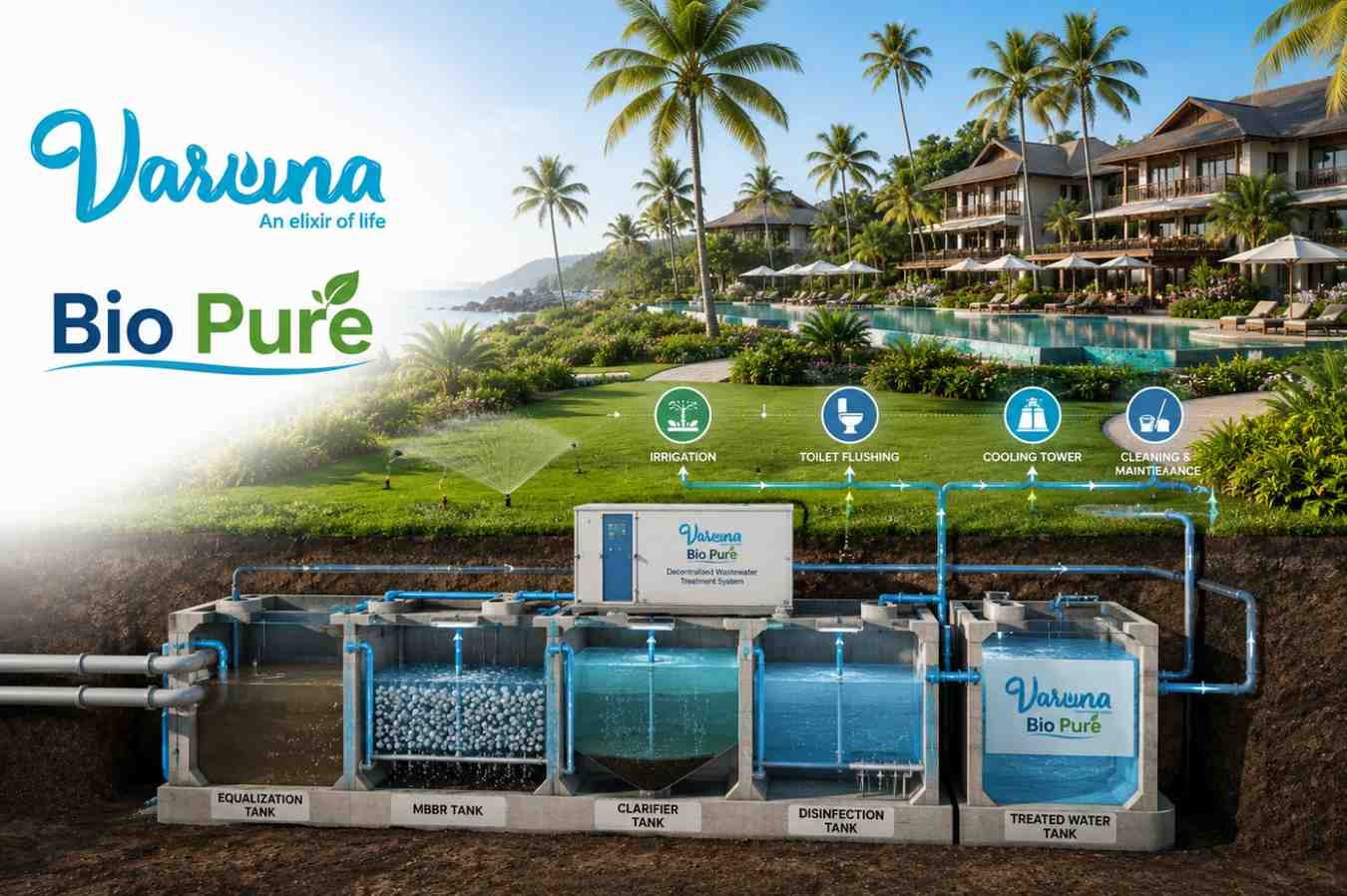
When treated, water can be reused for the following:
- Landscape irrigation
- Toilet flushing
- Maintenance activities
- Cooling applications
freshwater demand decreases without requiring guests to change their behavior.
Where Does Varuna Bio Pure Fit In?
This is where Varuna Bio Pure Decentralized Treatment Systems enter the conversation.
The idea isn't simply to treat wastewater.
The larger goal is to help properties create a more circular approach to water management.
Instead of relying entirely on freshwater supplies, resorts can recover value from water that has already served one purpose.
Potential Applications of Treated Water
- Landscape irrigation
- Toilet flushing
- Cooling systems
- Outdoor cleaning
- Maintenance operations
For many hospitality businesses, this creates a practical path toward:
- Improved sustainability
- Reduced freshwater consumption
- Better resource utilization
- Long-term operational efficiency
Perhaps more importantly, conservation efforts happen largely behind the scenes.
Guests continue enjoying the same experience.
Operations become more resource-efficient.
Centralized vs. Decentralized: Which Is Better?
This question comes up frequently.
And the honest answer is that it depends.
Centralized systems can work extremely well where robust municipal infrastructure already exists.
However, not every resort operates under those conditions.
Examples include:
- Remote destinations
- Island properties
- Eco-resorts
- Large hospitality developments
Each faces different challenges.
In these situations, decentralized wastewater treatment systems may provide:
- Greater flexibility
- Improved water reuse opportunities
- Reduced infrastructure dependence
- Better water security
Rather than asking which system is universally better, it's often more useful to ask which system aligns best with the property's location, infrastructure, and long-term goals.
The Growing Interest in Decentralized Wastewater Treatment Systems in India
India's hospitality sector is expanding rapidly.
At the same time, many regions are experiencing increasing pressure on water resources.
That combination is creating new conversations around water efficiency.
Industry stakeholders are focusing on:
- Water planning
- Resource optimization
- Sustainable infrastructure
- Wastewater reuse
As a result, interest in decentralized wastewater treatment systems in India continues to grow.
Not because it's a trend.
Because water management is becoming a strategic priority.
A Different Way to Think About Water
Perhaps the most interesting shift happening right now isn't technological.
It's philosophical.
For years, water management focused on consumption.
Questions included:
- How much water is being used?
- How can usage be reduced?
Those questions still matter.
But another question is becoming equally important:
How many times can the same water create value before it leaves the property?
That's where water reuse changes the conversation.
And that's where decentralized treatment systems offer something more than compliance.
They offer efficiency.
Final Thoughts
Most resorts don't have a wastewater problem.
They have a water efficiency opportunity.
The distinction matters.
When wastewater is viewed purely as a disposal issue, its potential value is overlooked.
When it's viewed as a recoverable resource, new possibilities emerge.
That's why more hospitality businesses are exploring solutions such as Varuna Bio Pure Decentralized Treatment Systems.
Not simply to meet regulations.
Not simply to support sustainability goals.
But to build a smarter and more resilient approach to water management.
Key Takeaways
- Water conservation in resorts is becoming a business priority.
- Decentralized wastewater treatment systems enable on-site treatment and reuse.
- Varuna BioPure Decentralized Treatment Systems support sustainable water management.
- Treated water can be reused for irrigation, flushing, cooling, and maintenance.
- Water reuse helps reduce freshwater consumption without affecting guest experience.
In an industry where every resource matters, learning how to use water twice may prove just as important as learning how to use less of it.