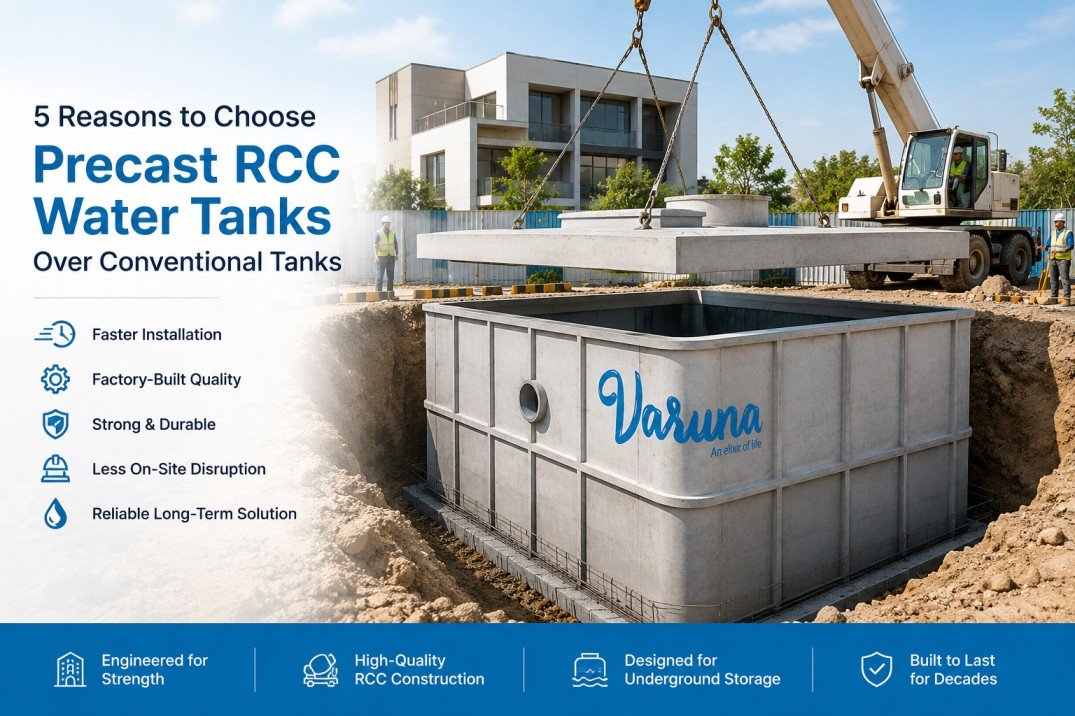
5 Reasons to Choose Precast RCC Water Tanks Over Conventional Tanks
Discover 5 key benefits of precast RCC water tanks, from faster installation and durability to reduced site work and long-term water storage.
Introduction
Water storage sounds simple until you actually have to build it.
Homes, offices, factories, schools—pretty much every kind of building needs somewhere to store water. But how that tank actually gets built changes a lot more than people expect. Installation time, how long it lasts, and how much upkeep it needs later—all of that traces back to the construction method.
The old way? Build it right there on-site. Excavation, reinforcement, shuttering, pouring concrete, waiting for it to cure, and repeating through several stages.
A precast RCC water tank skips most of that.
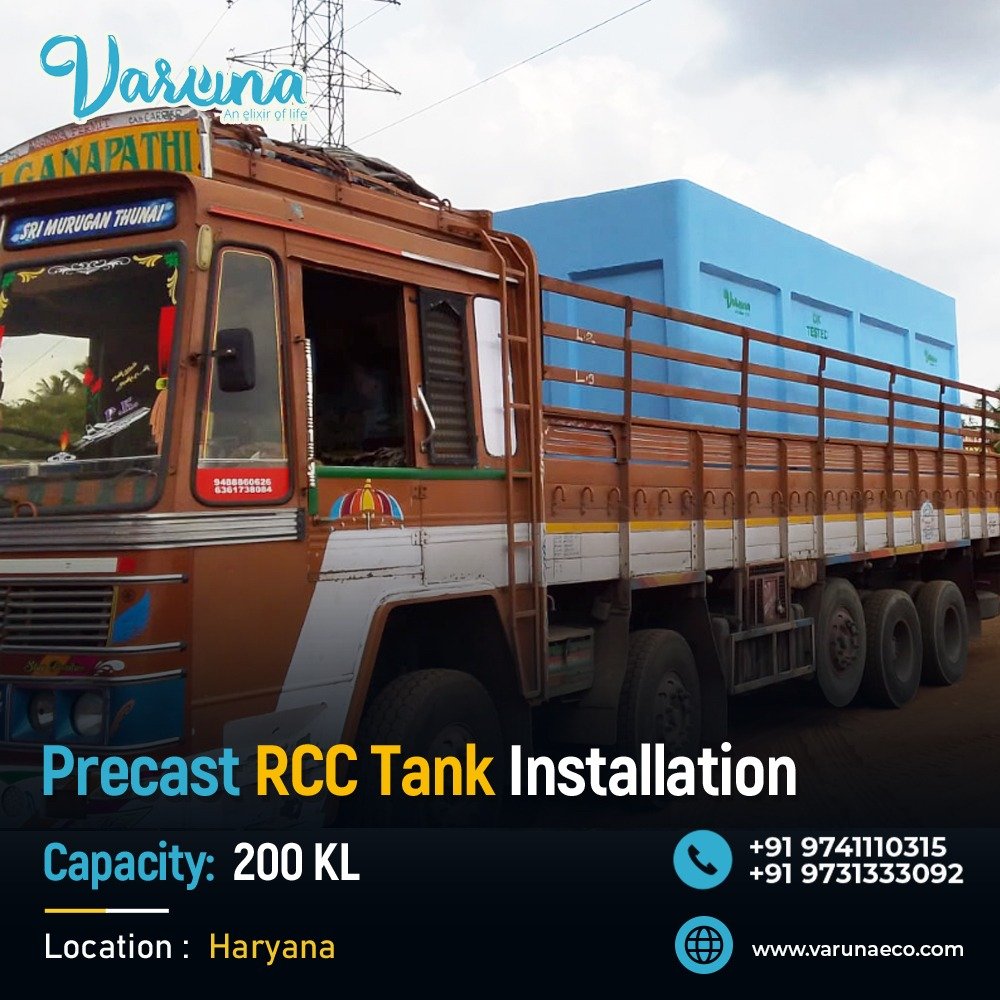
These tanks get manufactured somewhere else, under controlled conditions, then brought to your site and put together. Less mess, less waiting, and you still end up with a strong, durable tank at the end of it.
So why actually go precast? Here are five solid reasons.
1. It Gets Installed Faster—Which Speeds Up the Whole Project
This is probably the biggest draw of a precast RCC water tank—speed.
Building a tank the conventional way means going through a long sequence, one step after another:
Excavation → reinforcement → shuttering → concrete work → curing → waterproofing → finishing
Every one of those stages adds days, sometimes weeks, to your schedule.
Precast flips that around. Most of the tank gets built ahead of time in a factory, then shows up ready to install.
What does that actually mean for you?
- Less construction activity happening on your site
- Easier project scheduling overall
- Way less dependence on long civil work timelines
- Fewer disruptions to whatever else is going on at the site
- Your water storage system is up and running sooner
If you're working against a tight deadline, this alone can be reason enough to go precast.
2. It's Built in a Factory, Not Guessed at On-Site
A conventional tank gets built right there at the project location. Which means quality depends on a lot of moving parts:
- How materials get handled
- Whether reinforcement is placed correctly
- How the concrete gets mixed
- The skill of whoever's doing the work
- Whatever the weather decides to do that week
- How well curing is managed
- How closely the site is supervised
A precast concrete water tank doesn't carry all that uncertainty. It's made in a controlled production setup, away from weather and site chaos.
That control means more consistency — tank to tank, batch to batch.
For something meant to sit there working for years, that kind of consistency actually matters. A lot.
3. It's Just Strong, Durable Construction
Water tanks take a beating over time — pressure, weather, soil movement, years of continuous use. RCC has been the go-to material for infrastructure like this for a reason: it holds up.
A well-engineered RCC water storage tank handles that long-term demand without much trouble.
Precast takes that same reinforced concrete strength and adds factory-level manufacturing control on top of it. You get both.
Depending on the design, precast RCC tanks work well for:
- Underground water storage
- Residential projects
- Apartment complexes
- Commercial buildings
- Schools and institutions
- Industrial facilities
- Larger infrastructure projects
Of course, the tank still needs to be designed around its actual capacity, structural needs, soil type, and how it's going to be installed — none of that changes just because it's precast.
4. Way Less Construction Mess On-Site
Building a tank conventionally means a lot happening right there at your location — materials piling up, workers coordinating, shuttering systems, concrete trucks, the whole operation.
For a busy commercial or industrial site, that's often more disruption than anyone wants.
An underground RCC water tank built with precast methods moves most of that manufacturing work off-site entirely.
Which cuts down on:
- Materials stored on-site
- Construction congestion getting in everyone's way
- Labour needed just for tank-building
- Long stretches of civil work
- General disruption to daily operations
If space is already tight at your site, this matters even more.
5. It's a Practical Long-Term Storage Solution
A water tank isn't a one-time construction task you forget about. It's infrastructure that's going to sit there and do its job for years, maybe decades.
Which is exactly why durability, accessibility, and maintenance ease actually matter when you're picking one.
Precast RCC tanks bring together:
Strength + controlled manufacturing + faster installation + less on-site disruption
That combination is what makes them a practical pick for projects that need water storage they won't have to think about again for a long time.
Precast vs Conventional: A Quick Comparison
|
Feature |
Precast RCC Water Tank |
Conventional On-Site Tank |
|
Manufacturing |
Built in a controlled factory setting |
Built mostly on-site |
|
Installation |
Generally faster |
Multiple sequential stages |
|
Site Work |
Lower |
Usually higher |
|
Construction Time |
Often shorter |
Often longer |
|
Quality Control |
Factory-controlled |
Depends heavily on site execution |
|
Weather Impact |
Minimal during manufacturing |
Significant during construction |
|
On-Site Labour |
Reduced |
Higher |
|
Durability |
Strong RCC construction |
Depends on design and execution |
|
Maintenance |
Depends on design and use |
Depends on design and execution |
Which one's right for you really comes down to your project's requirements, site conditions, capacity needs, and budget.
Why Conventional Construction Tends to Drag On
Building an RCC tank entirely on-site means a long chain of steps that have to happen in order—you can't skip ahead.
Concrete, for example, needs proper curing time before anything else can move forward. There's no rushing that.
Weather adds another layer of unpredictability. Heavy rain alone can throw off:
- Excavation work
- Concrete pouring
- Moving materials around
- Access to the site
- How much labour actually gets done that day
Put it all together, and scheduling gets messy—especially on a project that was already tight on time to begin with.
Precast sidesteps a lot of this simply because the manufacturing happens somewhere the weather can't touch it.
Do Precast RCC Tanks Work Underground?
Yes—a properly designed underground RCC water tank works fine for most water storage needs.
Going underground makes the most sense where surface space is limited, which is basically every dense urban site these days.
Apartment complexes and commercial buildings, for instance, often go underground specifically to keep the surface free for:
- Parking
- Landscaping
- Driveways
- Recreation areas
- Other building infrastructure
That said, underground installation isn't something you just do without checking a few things first—soil conditions, groundwater levels, structural loads, access points, drainage. Proper engineering and a real site assessment need to happen before anything goes in the ground.
Where Do Precast RCC Tanks Actually Get Used?
RCC construction is versatile enough to fit almost anywhere water storage is needed.
- Residential Projects Apartments, villas, housing developments — all benefit from reliable RCC storage.
- Commercial Buildings Offices, shopping centres, restaurants — water storage just becomes part of the infrastructure.
- Industrial Facilities Different industries, different storage needs — RCC tanks adapt depending on the process involved.
- Schools & Institutions Campuses, hostels, colleges — dependable storage is basically non-negotiable here.
- Hospitals Healthcare facilities can't afford water availability issues — reliable storage is critical.
- Hotels & Resorts Hospitality projects often need large-capacity storage as part of their utility setup.
How to Actually Choose the Right Tank
Don't just grab the biggest capacity you can find and call it done.
Before buying a precast RCC water tank, think through:
- Required capacity: figure out actual daily water needs, not a rough guess.
- Installation location: underground, or some other setup that fits the site better.
- Available space: access for cranes, room to install, what's around the site.
- Structural requirements: soil conditions, water pressure, external loads, installation specifics.
- Intended use: drinking water, domestic storage, fire water, rainwater harvesting — each one has different demands.
- Installation method: how it gets transported, unloaded, positioned, connected, and finally commissioned.
Precast RCC Tanks and Rainwater Harvesting
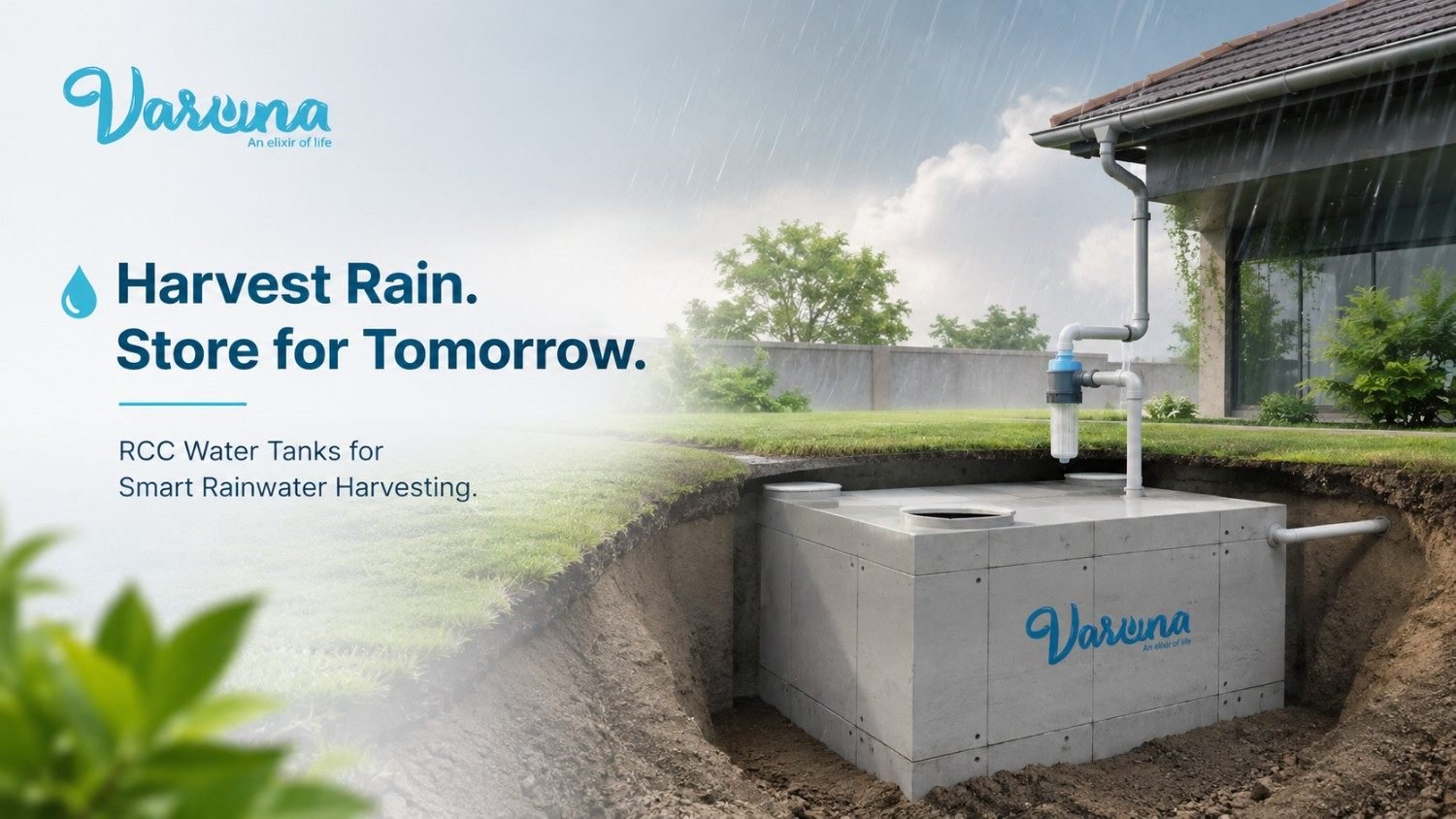
These tanks aren't just for everyday water storage — they fit naturally into a rainwater harvesting setup too.
Rain collected off rooftops or other catchment areas gets filtered and directed into the tank for storage. From there, it can be used for suitable applications, depending on quality and local requirements.
That gives you a simple cycle:
Rainfall → collection → filtration → RCC storage tank → suitable reuse
Pair that with durable storage infrastructure, and you've got a genuinely effective way to improve water conservation on a project.
Is a Precast Tank Actually Cheaper?
Depends on the project — there's no single answer here.
Looking only at the upfront purchase price misses most of the picture.
You need to weigh the total installation cost, including:
- Civil construction
- Labour
- Material handling
- Construction time
- Site logistics
- Equipment
- Waterproofing
- Maintenance
- Delays (because they always cost something)
A precast tank can genuinely save money through faster construction and less on-site work — but the real numbers depend heavily on your specific project conditions. Worth running the actual math rather than assuming either way.
Why Varuna for Precast RCC Water Tanks?
Varuna builds precast RCC water storage solutions for residential, commercial, institutional, and industrial projects.
The focus stays on solid, durable infrastructure, installed efficiently, built to perform reliably for years.
Depending on what your project needs, Varuna's tanks work for:
- Underground water storage
- Rainwater harvesting
- Domestic water storage
- Commercial water storage
- Industrial applications
- Institutional infrastructure
Capacity and configuration get worked out based on your actual water needs, site conditions, and how the tank needs to be installed — not a one-size-fits-all approach.
Conclusion
Choosing between a conventional tank and a precast RCC water tank isn't just a construction detail — it actually affects your timeline, how much disruption your site deals with, and how the whole thing performs years down the line.
Precast tanks bring real advantages to the table:
Faster installation. Controlled manufacturing. Solid RCC durability. Less on-site disruption. Reliable storage that lasts.
For builders, developers, industries, institutions, or property owners looking for a dependable water storage solution, precast RCC construction is a genuinely practical alternative to building the old way.
Just make sure the tank you pick actually matches your project's real requirements — not just whatever's cheapest or biggest on the list.