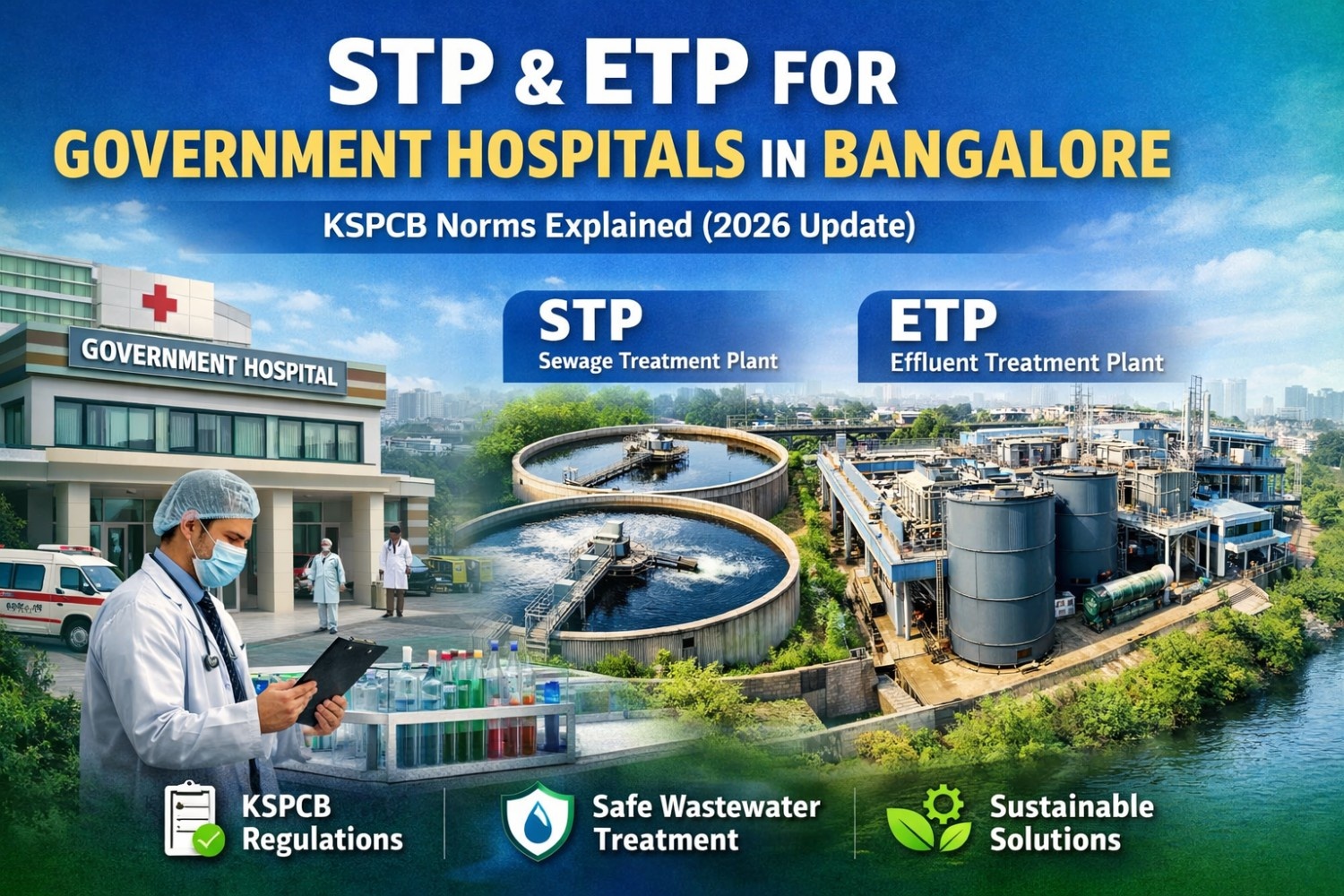
STP & ETP for Government Hospitals in Bangalore: KSPCB Norms Explained (2026 Update)
Learn KSPCB norms for STP & ETP in Bangalore government hospitals (2026). Ensure compliance, safe wastewater treatment, and sustainable infrastructure.
Walk into a government hospital in Bangalore on any weekday morning and you’ll see movement everywhere—patients waiting outside OPDs, stretchers being pushed down corridors, nurses shifting between wards, and lab technicians handling samples non-stop.
It’s organized chaos.
What most people never think about is what happens after every procedure, every cleaning cycle, every dialysis session—where all that used water goes.
The water that sterilized surgical tools.
The rinse from isolation wards.
The discharge from laboratories.
It doesn’t simply disappear into the ground.
And unlike domestic sewage, hospital wastewater isn’t ordinary. It can carry bacteria, chemical disinfectants, pharmaceutical residues, and sometimes even traces of antibiotics. That’s exactly why treatment systems are no longer optional infrastructure.
For government hospitals in Bangalore, wastewater treatment falls under the regulatory framework of the Karnataka Pollution Control Board (KSPCB). And in 2026, oversight has become stricter, documentation tighter, and performance expectations clearer—something wastewater specialists like Varuna, who work closely with public healthcare facilities, are seeing firsthand.
Why Government Hospitals Cannot Ignore Wastewater Treatment
A mid-sized government hospital can discharge thousands of liters of wastewater every single day. During seasonal outbreaks or emergency surges, those numbers climb even higher.
This discharge may contain:
- Biological contaminants
- Chemical lab effluent
- Pharmaceutical traces
- Blood-contaminated wash water
If released untreated, it can contaminate groundwater, overload municipal sewer systems, and contribute to antimicrobial resistance—a growing global concern.
That’s why KSPCB requires structured treatment systems before discharge. It isn’t just regulatory pressure. It’s a public health safeguard. Experienced environmental solution providers such as Varuna emphasize that proper design at the initial stage prevents long-term compliance issues.
What the 2026 KSPCB Update Means for Hospitals
In recent years, regulatory monitoring has become more data-driven. It’s no longer enough to simply install a plant and assume compliance.
Authorities look at performance.
Treated discharge must meet specific standards. Typically, this includes maintaining Biochemical Oxygen Demand (BOD) below 30 mg/L, Chemical Oxygen Demand (COD) within prescribed limits, controlled suspended solids, and balanced pH levels.
But numbers alone don’t define compliance.
Hospitals are also expected to:
-
Secure Consent to Establish before installation
-
Obtain Consent to Operate once operational
-
Maintain monitoring records
-
Allow inspections when required
Documentation gaps are often where hospitals face trouble—not necessarily the plant itself. This is where technical planning and documentation support from experienced firms like Varuna become critical.
STP and ETP: Why One System Is Not Enough
One of the most common misconceptions is assuming a single treatment system can handle all hospital wastewater. In practice, that approach rarely works well.
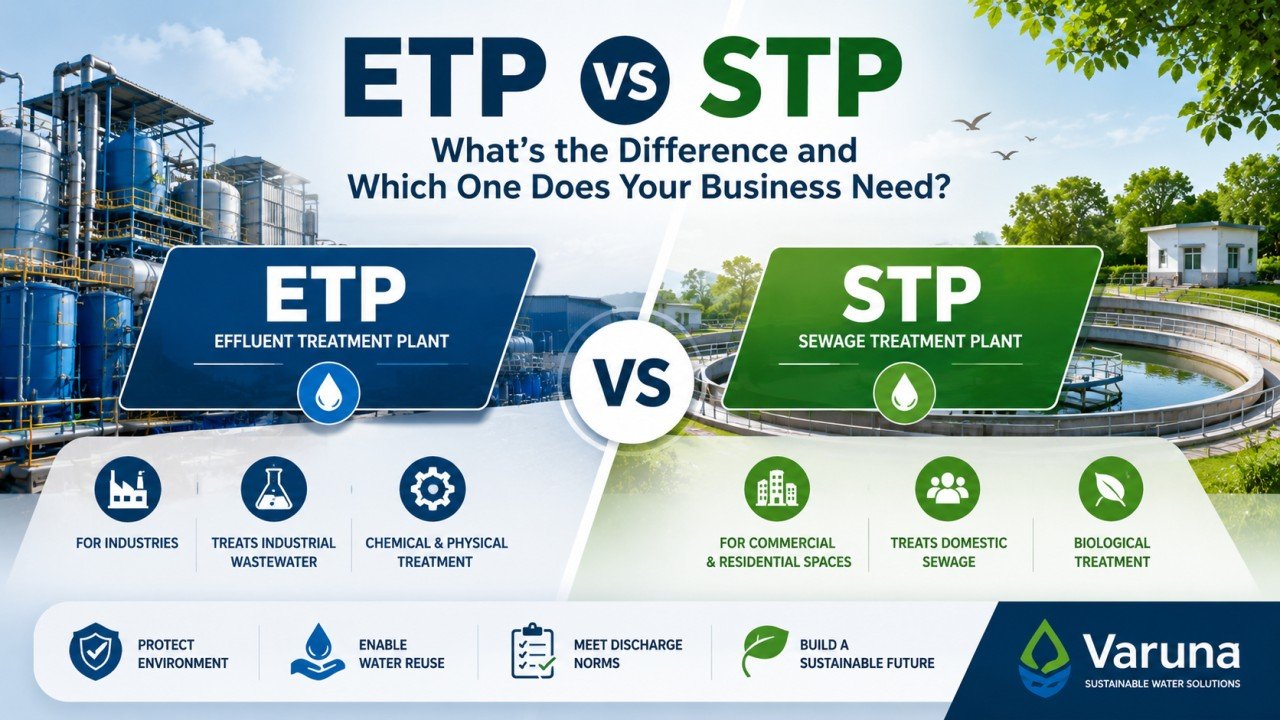
An STP manages domestic sewage—discharge from wards, toilets, kitchens, and general cleaning. It primarily relies on biological processes where microorganisms break down organic matter. After treatment and disinfection, the water may be reused for non-potable purposes such as gardening or flushing.
This system works effectively for regular sewage.
But hospital wastewater isn’t limited to regular sewage.
Effluent Treatment Plant (ETP)
An ETP handles more complex discharge—especially from laboratories, pharmacies, and operation theaters. This effluent may contain chemicals that biological treatment alone cannot neutralize.
ETPs use a combination of chemical treatment, filtration, and sometimes advanced oxidation processes to remove hazardous compounds.
Because government hospitals generate both domestic and chemical discharge, dual systems are often the safest and most compliant solution.
Trying to combine everything into one undersized plant may reduce capital costs initially—but it often creates long-term compliance problems.
Planning the Right Capacity
Designing a wastewater treatment system isn’t just about counting beds.
While bed strength is important, planners must also consider:
- Daily OPD footfall
- Dialysis units
- Laboratory workload
- Staff strength
- Future expansion
Most government hospitals fall somewhere between 50 and 500 KLD in treatment capacity, but proper sizing should always begin with a wastewater audit. Technical audits conducted by companies like Varuna help determine realistic discharge loads rather than relying on assumptions.
Another factor many overlook is fluctuation. During epidemics or seasonal disease spikes, patient numbers rise sharply. Treatment systems must be able to handle peak loads — not just average conditions.
The Approval Process: More Than Just Paperwork
Obtaining KSPCB clearance follows a structured path.
First comes assessment—understanding how much wastewater is generated and what it contains. Then comes system design and submission for Consent to Establish. Only after installation and satisfactory trial runs can Consent to Operate be granted.
While the process is straightforward on paper, delays usually happen due to incomplete documentation or poorly designed systems. Planning correctly from the beginning reduces approval friction significantly—something Varuna’s compliance-focused approach is built around.
Practical Challenges Government Hospitals Face
Public healthcare infrastructure often operates under constraints.
Budget allocations are tied to tender processes. Older hospital campuses may have limited space. Maintenance teams may not always have specialized wastewater expertise.
And then there’s the issue of antibiotic and chemical load—something many standard systems aren’t designed to handle efficiently.
Installation is only one part of the equation. Regular operation and monitoring determine whether the system truly remains compliant. This is why long-term O&M planning, often provided by specialists like Varuna, becomes essential.
Why Proper Installation Benefits Hospitals Long Term
For many administrators, wastewater treatment feels like a regulatory obligation. But there are broader benefits.
Compliant systems:
- Protect groundwater and nearby communities
- Reduce risk of penalties
- Enable treated water reuse
- Lower dependence on freshwater tankers
- Strengthen institutional credibility
For public institutions, environmental responsibility directly influences public trust—and professional implementation partners such as Varuna help hospitals align infrastructure with that responsibility.
Emerging Trends in 2026
Wastewater management is evolving.
Modern systems increasingly incorporate:
- Real-time monitoring tools
- Energy-efficient aeration systems
- Modular installations for space-limited campuses
- Advanced processes targeting antibiotic residues
Hospitals that invest in modern, well-designed systems position themselves ahead of compliance pressure rather than reacting to it—a direction companies like Varuna are actively promoting across public healthcare infrastructure projects.
Final Thoughts
Wastewater treatment rarely receives the same attention as medical equipment or building expansion. It operates quietly in the background.
But when it fails, the consequences are immediate and visible.
For government hospitals in Bangalore, installing properly designed STP and ETP systems is not merely about meeting KSPCB norms. It is about ensuring that healthcare delivery does not create environmental or public health risks beyond hospital walls.
In 2026, expectations are clear. Oversight is tighter. Planning ahead is essential.
Responsible infrastructure today prevents avoidable problems tomorrow — and with experienced partners like Varuna, hospitals can approach compliance with confidence.
Need Guidance for STP & ETP Installation?
If your government hospital is planning installation, upgrading an outdated system, or navigating regulatory approvals, technical guidance can make the process smoother and faster.
Varuna provides compliant, practical, and sustainable STP & ETP solutions tailored specifically for government hospitals in Bangalore.
Because in healthcare infrastructure, what happens behind the scenes matters just as much as what happens inside the wards.
FAQs
1. Is wastewater treatment compulsory for government hospitals?
Yes. Hospitals above specified capacity must install treatment systems as per pollution control regulations.
2. Why do hospitals need both STP and ETP?
Because domestic sewage and chemical laboratory discharge require different treatment approaches.
3. What are the key discharge limits hospitals must follow?
Typically limits apply to BOD, COD, suspended solids, and pH levels to ensure safe discharge.
4. What approvals are required before operating a treatment plant?
Hospitals must obtain Consent to Establish and Consent to Operate from the pollution control authority.
5. How is plant capacity determined?
Capacity depends on bed strength, patient load, lab activity, and total wastewater generation.
6. Can treated water be reused inside hospital premises?
Yes, usually for non-potable uses such as flushing or landscaping.
7. What happens if a hospital fails to comply?
Non-compliance may lead to penalties, notices, or operational restrictions.