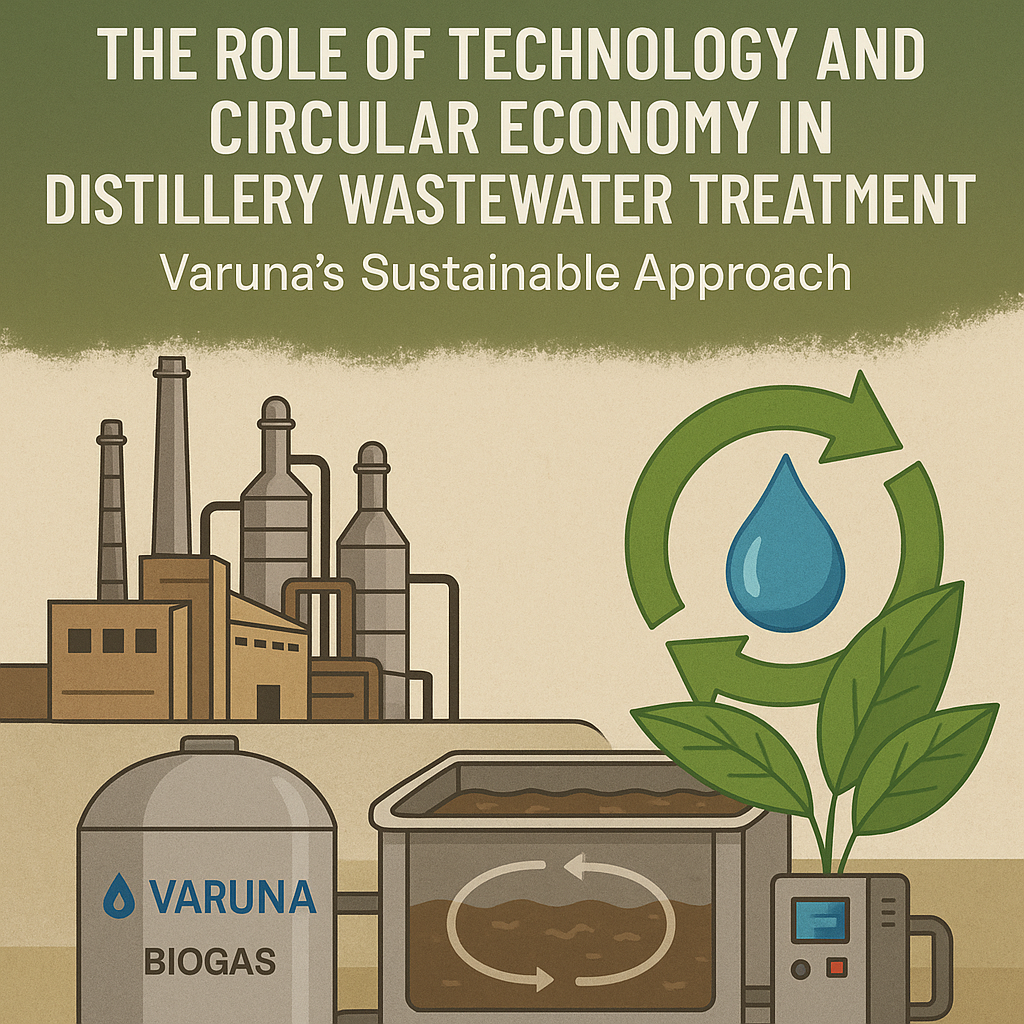
The Role of Technology and Circular Economy in Distillery Wastewater Treatment: Varuna’s Sustainable Approach
Explore how Varuna integrates advanced technology and circular economy principles to transform distillery wastewater into reusable water, renewable energy, and sustainable resources while ensuring full regulatory compliance.
Introduction: Transforming Waste into Worth
The Indian distillery sector plays a vital role in the country’s agro-based economy — converting molasses, grains, and fruits into ethanol, spirits, and biofuels. But this success also brings a significant environmental challenge: managing distillery wastewater, which is one of the most complex industrial effluents due to its high organic load, colour, and odour.
As the Government of India tightens environmental norms, particularly for high-polluting industries, distilleries are under increasing pressure to operate sustainably. However, this challenge also presents an opportunity — to rethink wastewater not as waste, but as a resource.
That’s where Varuna comes in.
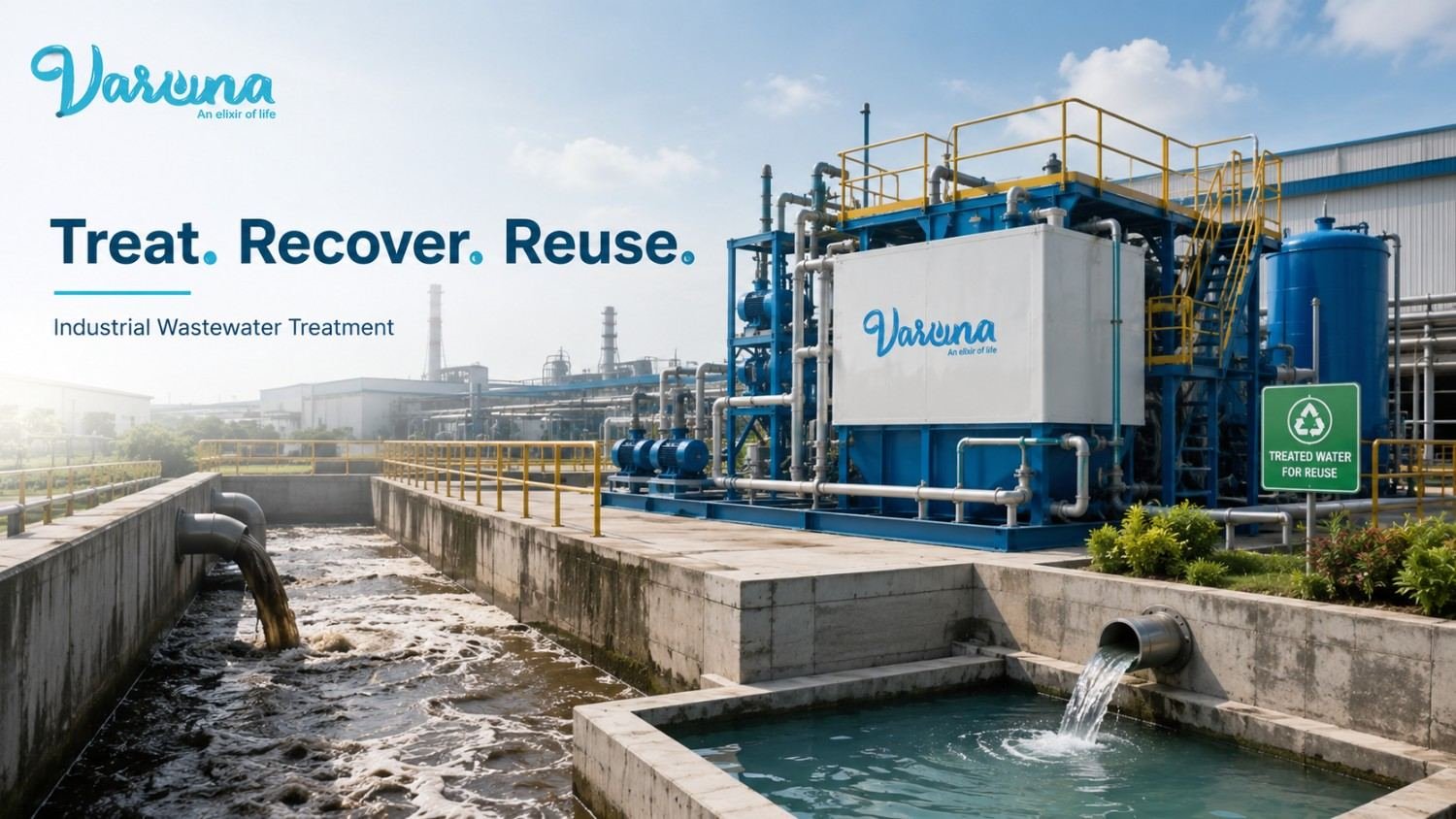
With decades of experience in industrial wastewater treatment, recycling, and energy recovery, Varuna is helping distilleries across India move towards a circular economy — one that turns effluent into energy, sludge into compost, and wastewater into reusable water, ensuring zero harm to the environment.
The Wastewater Challenge in the Distillery Industry
A typical distillery produces 8 to 15 litres of spent wash per litre of alcohol. This effluent contains:
- High Biochemical Oxygen Demand (BOD) and Chemical Oxygen Demand (COD)
- High concentrations of organic matter, sulphates, and nitrogen
- Suspended solids, yeast residues, and fermentation by-products
- Strong odour and dark brown colour
If untreated, this effluent can deplete oxygen levels in water bodies, contaminate groundwater, and damage soil quality — posing a serious threat to the environment and public health.
Given that distilleries are among the 17 highly polluting industries identified by the Central Pollution Control Board (CPCB), the Karnataka State Pollution Control Board (KSPCB) and other State Boards have laid out detailed guidelines to ensure safe collection, treatment, and disposal of effluents.
But compliance alone is not enough. The modern industrial ecosystem demands innovation, efficiency, and sustainability — all of which are possible through the integration of technology and circular economy principles.
Technology: The Cornerstone of Sustainable Effluent Management
At Varuna, technology is not just a tool — it’s a transformation driver. Every distillery project we undertake is designed around smart, efficient, and adaptive technologies that minimize environmental impact while maximizing recovery and reuse.
Here’s how technology is revolutionizing distillery wastewater treatment:
Smart Effluent Collection and Storage Systems
Varuna designs impervious lagoons and tanks lined with concrete, stone masonry, or HDPE with reinforcement to prevent seepage and groundwater contamination.
Our advanced SCADA-based monitoring systems track flow, pH, and temperature in real-time, helping operators maintain consistent treatment conditions and detect issues early.
This ensures complete containment and compliance with State guidelines that prohibit effluent discharge into rivers or land.
Anaerobic Digestion: Turning Waste into Energy
Anaerobic digesters have become a game-changer in the distillery sector.
Varuna’s closed-type anaerobic digesters are engineered to handle high organic loads and recover methane-rich biogas efficiently. This biogas can be used for:
- Steam generation in boilers
- Electricity generation through biogas engines
- Supplementing distillery energy needs
By capturing methane instead of letting it escape, Varuna systems reduce greenhouse gas emissions and align with India’s Net Zero commitments.
This process not only makes wastewater treatment energy-neutral, but in many cases, energy-positive — a perfect example of circular economy in action.
Advanced Secondary and Tertiary Treatment
After primary anaerobic digestion, the effluent still contains residual colour and dissolved organics.
Varuna integrates secondary and tertiary technologies to meet stringent discharge standards:
- Anaerobic Hybrid Reactors (AHRs) and Moving Bed Biofilm Reactors (MBBRs) for enhanced BOD/COD removal
- Membrane Bioreactors (MBRs) and Ultrafiltration (UF) for high-quality water recovery
- Advanced Oxidation Processes (AOPs) for colour and odour reduction
- Reverse Osmosis (RO) for final polishing and recycling
This multi-stage approach ensures that effluent meets — and often surpasses — CPCB norms, allowing for safe reuse in irrigation, cooling towers, or cleaning operations.
Zero Liquid Discharge (ZLD): Closing the Loop
The cornerstone of Varuna’s approach to sustainable wastewater management is Zero Liquid Discharge (ZLD).
Under ZLD, no wastewater is released into the environment — instead, it is treated, concentrated, and recycled within the plant.
Our ZLD systems include:
- Evaporators to concentrate the spent wash
- Crystallisers to recover salts
- Condensate Polishing Units (CPU) for recovering reusable water
- Sludge management units for safe handling of solids
This approach helps distilleries comply with government mandates, especially in sensitive zones, and drastically reduces freshwater dependency.
Automation and Data-Driven Management
Traditional treatment plants often fail due to inconsistent operations. Varuna solves this by integrating automation and IoT-based monitoring systems.
Key technologies include:
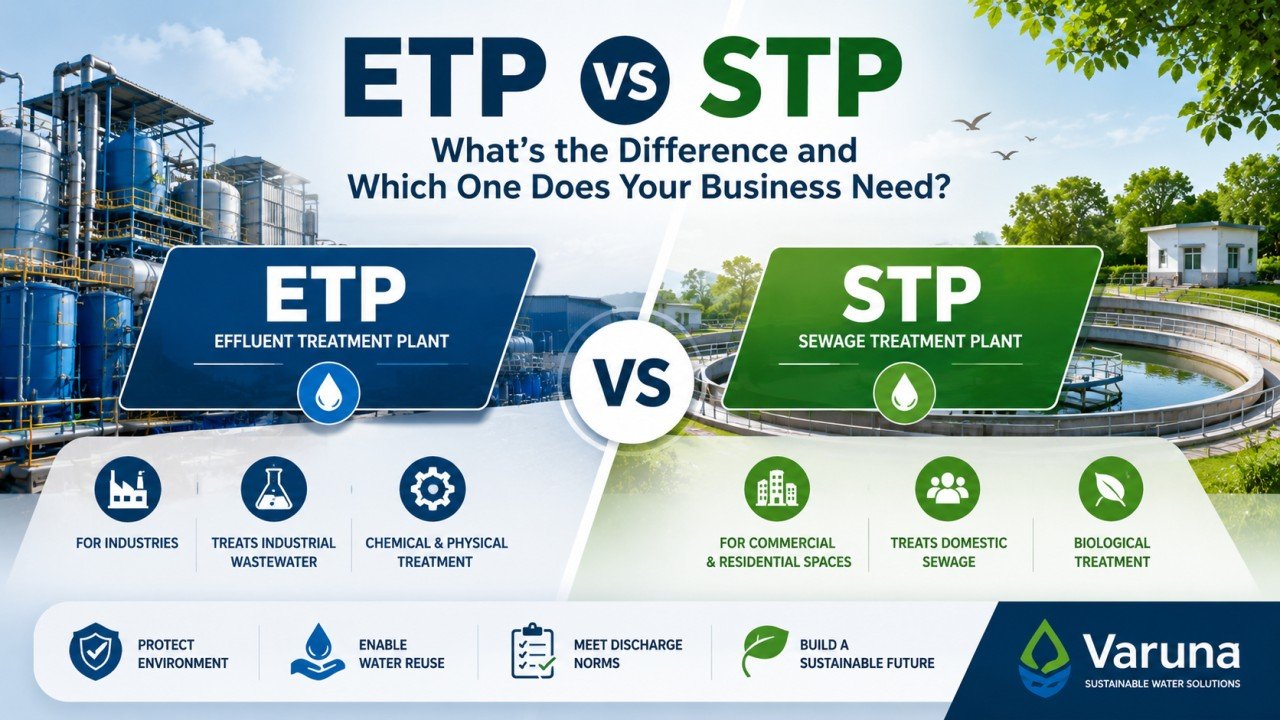
- SCADA-controlled ETPs (Effluent Treatment Plants)
- Remote sensors for real-time BOD/COD monitoring
- AI-based performance analytics to optimize treatment cycles
- Cloud-based dashboards for environmental compliance tracking
This digital integration enables predictive maintenance, reduces downtime, and ensures continuous regulatory reporting — aligning with the government’s vision for smart, transparent, and traceable industries.
Circular Economy: From Linear Waste to Regenerative Flow
Traditionally, industries followed a linear model — take, make, and waste. But the circular economy transforms this approach into a closed-loop system, where waste becomes a valuable resource.
Varuna’s wastewater management philosophy is deeply rooted in this model.
Here’s how we enable circularity in distillery operations:
Resource Recovery and Reuse
Every drop of treated water is an asset. Varuna’s treatment systems recover up to 95–98% of wastewater, converting it into high-quality water suitable for reuse.
Recovered resources include:
- Water for irrigation or cooling
- Biogas from anaerobic digestion
- Nutrient-rich sludge for composting and soil enrichment
This minimizes raw material consumption and helps distilleries achieve sustainable profitability.
Composting and Soil Regeneration
In line with KSPCB guidelines, Varuna assists distilleries in developing scientifically managed composting facilities.
Here, the treated effluent is mixed with press mud, bagasse, or other filler materials from nearby sugar mills to produce bio-compost — a nutrient-rich organic fertilizer.
This closed-loop process supports agriculture while ensuring safe disposal of organic solids, strengthening the industry-agriculture synergy that defines India’s green economy.
Energy Neutral Operations
The biogas generated from wastewater provides a renewable energy source for boilers and power generation, reducing dependency on fossil fuels.
Many of Varuna’s client distilleries have achieved energy-neutral or even energy-positive operations by using biogas and solar energy together — cutting carbon footprints while saving operational costs.
Water Circularity and Conservation
The government mandates a maximum of 15 cubic meters of water per kilolitre of alcohol produced.
Varuna helps distilleries achieve this target through:
- Water auditing and metering systems
- Condensate recovery and reuse loops
- Smart flow optimization
- Continuous monitoring for water efficiency
By recovering and reusing treated water, Varuna systems reduce freshwater intake by up to 80%, ensuring compliance with the Water (Prevention and Control of Pollution) Cess Act and supporting the national Jal Shakti Abhiyan goals.
Compliance with Environmental and Regulatory Standards
Every new or expanding distillery must submit an Environmental Impact Assessment (EIA) and Environmental Management Plan (EMP).
Varuna supports industries in preparing, implementing, and maintaining these plans through:
- Remote sensing and GIS-based site analysis
- Groundwater monitoring using test wells
- Real-time effluent quality testing in in-house laboratories
- Annual Environment Statement Reports (ESR) submissions
This ensures long-term compliance, transparency, and alignment with India’s National Green Tribunal (NGT) directives.
Varuna’s Integrated Approach: Beyond Compliance
Varuna doesn’t just provide treatment plants — we deliver end-to-end environmental engineering solutions that combine science, sustainability, and strategy.
Our approach includes:
- Detailed Feasibility Studies — Understanding site conditions, effluent characteristics, and local ecology.
- Customised Design & Engineering — Tailoring solutions for specific distillery processes.
- Turnkey Execution — From civil work to commissioning.
- Training & Capacity Building — Empowering plant operators with skills and knowledge.
- Operation & Maintenance Support — Ensuring long-term performance and compliance.
With Varuna, industries not only meet legal obligations but also create sustainable business value through resource efficiency, energy recovery, and reduced operating costs.
Driving Innovation: The Future of Wastewater Management
The future of distillery wastewater treatment is about integration, innovation, and intelligence.
Varuna is investing in emerging technologies such as:
- AI-driven process optimization for real-time performance enhancement
- Microbial culture engineering for faster organic degradation
- Nanotechnology-based filtration membranes for superior water recovery
- Hybrid solar-biogas systems for decentralized energy generation
- Blockchain-enabled traceability systems for transparent environmental reporting
These advancements are transforming how distilleries perceive wastewater — from a liability into an opportunity for sustainability and profitability.
Case in Point: Circular Success with Varuna
Across India, several distilleries have partnered with Varuna to adopt eco-efficient wastewater systems.
For example, one molasses-based distillery in Karnataka implemented Varuna’s Anaerobic Digester + MBR + ZLD solution and achieved:
- 97% water recovery
- 35% reduction in power consumption through biogas energy reuse
- 100% compliance with KSPCB norms
- Zero discharge into land or water bodies
This project became a benchmark in sustainable distillery operations, proving that green technology can also be economically rewarding.
The Bigger Picture: Circular Economy and National Sustainability Goals
Varuna’s work in distillery wastewater management directly supports India’s broader environmental goals, including:
- Swachh Bharat Mission (Clean Industry initiatives)
- Jal Jeevan Mission (Water conservation)
- National Bioenergy Programme (Biogas utilization)
- Paris Agreement & Net Zero 2070 targets
By promoting water reuse, waste-to-energy conversion, and circularity, Varuna is helping India move toward a regenerative industrial ecosystem where resources are used responsibly and continuously.
Conclusion: Engineering a Sustainable Tomorrow
The future of industrial sustainability lies in the marriage of technology and circular economy.
As a trusted partner to the distillery industry, Varuna continues to lead this transformation — not just by treating wastewater, but by redefining it as a renewable resource.
Through advanced technologies, smart automation, and eco-centric design, we are helping distilleries achieve:
✅ Zero Liquid Discharge
✅ Energy self-sufficiency
✅ Water reuse and conservation
✅ Environmental compliance and social responsibility
In doing so, Varuna is not just building treatment plants — we’re building a future where every drop counts and every waste stream finds new purpose.
Because at Varuna, sustainability isn’t a goal — it’s our way of engineering progress. 🌿